Case study · retrospective
Hindsight, not a call. The dates below are public reporting, read afterwards. Early Trends did not write about air up in 2019, and this page is not a claim that we did. It is also not a promise that the bottle will taste like anything to you.
Retrospective Food & Drink
What it is
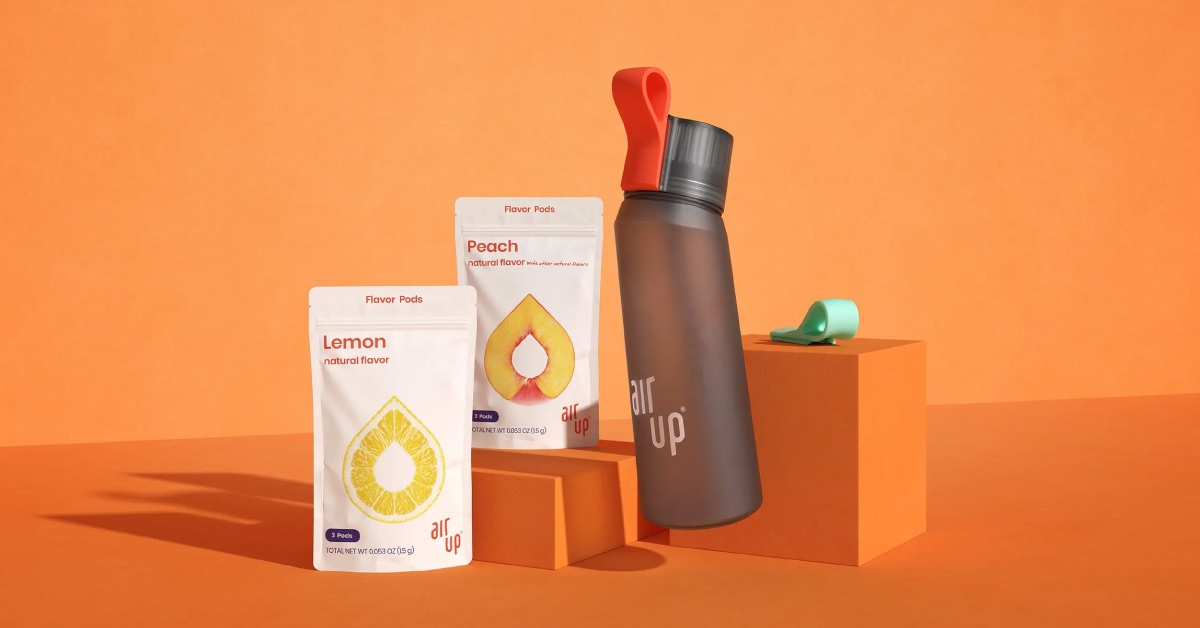
air up is a reusable bottle plus a small scent pod that sits by the mouthpiece. The company’s account, repeated by Food Dive, is retronasal smell: scent reaches the nose from the mouth and the brain files it as taste. The water stays water. Lena Jüngst and Tim Jäger started from that idea as product-design students. Munich Startup dates a first prototype to 2016 and the company to 2019. Five founders took it to market. Pods are a consumable. That matters later: a refill is not the same signal as a collectible trading above retail.
It is a wholesome object by our filter: water and scent, no alcohol. We do not repeat health or “bottles saved” figures as measured facts. DER SPIEGEL has argued the company’s bigger health and sustainability promises were not proven. The case study is about timing, not a wellness claim.
When each signal would have lit
A detector that waits for celebrity, then TikTok, then Google Trends, then resale meets air up in 2022. A detector that watches a first production run sell through meets it in 2019. There was no public crowdfunding blowout we could find, so that detector stays off. Crowdfunding alone would have needed a second signal anyway. The sell-out did not have to stand alone.
| When | Signal | What was public |
|---|---|---|
| 2016–mid-2019 | Prototype, not demand | Student experiments, then a company. INSIDE’s May 2022 special issue says three years passed from the first working prototype to a market start in mid-2019. No shopping signal yet. |
| About July 2019, then six to eight weeks | First-batch sell-out | The June 2022 US press release dates the European launch to July 2019. INSIDE’s revenue line for 2019 is €2.0 million and is labeled July to December, which fits that month. Jüngst told INSIDE the first 80,000 starter sets, made in China (bottle plus two pods), sold out within eight weeks. The company’s own about page says 80,000 bottles sold out in under six weeks. Food Dive, quoting her in 2022, says the first run sold out in two months. The week-count is not identical across tellings. The fact they agree on is the one that matters: the first production run was gone in about two months, in 2019. |
| Launch window, 2019 | Specialty shop, then a grocery experiment | A Bavarian founder interview describes the team standing in a Munich outdoor shop to demo the bottle when the first systems reached stores. INSIDE says they also forced listings into Rewe, Edeka, Aldi, hardware stores and Woolworth, then judged those placements as short promotions. In early 2020 they moved the core of the business to their own webshop. Müller and Rossmann, where the product was already in, stayed. The durable early evidence is the sell-out, not a permanent grocery endcap. |
| Before the sell-out | German TV investors, not a US celebrity user | INSIDE says Höhle der Löwen investors Frank Thelen and Ralf Dümmel, then Oyster Bay, funded the first production. That is a seed. It is also the money that paid for the batch. It is not the same event as a famous person drinking from the bottle on camera in America three years later. |
| 2019–2021 | Confirming demand, still pre-Hollywood | INSIDE’s table: €2 million in the second half of 2019, €20 million in 2020, €90 million in 2021, with €190 million planned for 2022. Food Dive reports the same path in dollars. A sell-out that is followed by a tenfold year is a second signal. This is still before the US launch. |
| Early years, then by May 2022 | Five-second wow, on YouTube before it was a US TikTok story | The trick fits in one breath: sip, then pinch your nose and the “flavor” drops out. INSIDE says that when budgets were thin the company leaned on YouTube, because a short video could explain the bottle cheaply. By the May 2022 interview the mix was Instagram, TikTok, Twitch, Facebook and YouTube, about a third each, with Twitch the focus of the moment. We score the wow as a format that was available in 2019. We do not treat a format as the demand proof. The 80,000-set sell-out is the demand proof. |
| May 2022 | Paid celebrity, still pre-US launch | The same interview cites a costly Chiara Ferragni cooperation in Italy as the kind of influencer invoice that arrived after the early period, when sending a free bottle was enough. It also says Ashton Kutcher and Mila Kunis were minority investors, and that a US launch was still ahead. Hollywood names are a 2022 fact. They are not a 2019 fact. |
| 28 June 2022 | US announcement | air up’s press release: US entry, more than two million customers, nine European countries already, and investors including PepsiCo, Ashton Kutcher and Guy Oseary. BevNET: direct-to-consumer first, starter sets at $39.99, pods in ten flavors. This is the moment a US celebrity-and-trade-press scan would notice the brand. |
| 28 July 2022 and 2 October 2022 | The late order, in English | Food Dive explains the mechanism a month after the US launch. BuzzFeed News, on 2 October 2022, is headlined as the TikTok-famous bottle and describes the nose-pinch clip. If you waited for that sequence, you are three years behind the German sell-out. |
| Search and resale | Not the early detectors | We are not quoting a Google Trends number we did not pull. English “what is this bottle?” coverage clusters in the second half of 2022. We also did not find a reseller premium like Labubu’s. The scarcity was the company being out of its own first batch. Later scarcity is a pod you have to reorder, which is a consumable, not a flip. |
The contrast, in one paragraph
Celebrity, then TikTok, then search, then resale is a real description of how air up looked to an American reader in the autumn of 2022. It is a bad description of how the product proved demand. The first 80,000 starter sets were gone in roughly six to eight weeks after a mid-2019 launch, the company’s 2019 sales were already counted from July, and the revenue line was €20 million the next year. German TV investors helped pay for that first batch. They are not a substitute for the sell-out, and they are not Ashton Kutcher on a 2022 press release. No Kickstarter total would have caught this. A specialty sell-out would have.
Where to buy
The button goes to a current air up Click starter set on Amazon.com: 27 oz, Rose Cobalt, five scent pods, sold by air up, in stock at $49.99 when we checked. ASIN B0GZVQ39SC. It is not the 2019 bottle in the BevNET photo. The listing had on the order of 149 ratings and a 3.2 average, with leak complaints and “I can’t taste it” in the review themes. That is a reason to treat this as a lesson about signals, not as a promise the pod will work on your nose. The Associates tag is earlytrends-20.
Sources
- INSIDE, May 2022 special issue (PDF) — eight-week sell-out of 80,000 sets, euro revenue, YouTube-then-TikTok, Kutcher and Kunis as investors
- air up press release, 28 June 2022 — July 2019 European launch and the US entry
- air up about page — 80,000 bottles sold out in under six weeks
- Gründerland Bayern — Munich outdoor-shop demos and the six-week sell-out in the founder interview
- Food Dive, 28 July 2022 — mechanism, first run sold out in two months
- BevNET — US direct-to-consumer launch, $39.99 starter sets
- BuzzFeed News, 2 October 2022 — the TikTok-famous bottle and the nose-pinch clip
- Munich Startup — prototype in 2016, company founded in 2019
- DER SPIEGEL — skepticism about the health and sustainability promises
- Amazon — air up Click 27 oz Rose Cobalt starter set, sold by air up